Tourexpi

Middle East tourism set for sharp 2026 decline before strong long-term recovery
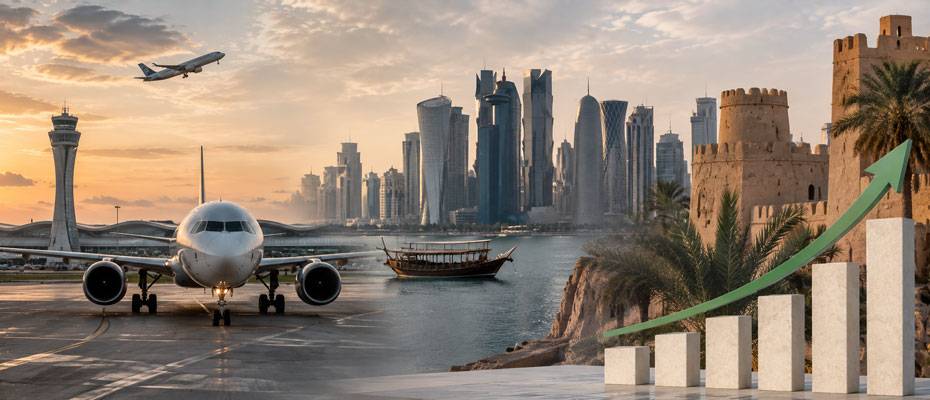
Travel & Tourism in the Middle East is facing a
significant short-term setback as geopolitical tensions disrupt airspace and
international travel flows. According to new forecasts from the World Travel
& Tourism Council (WTTC), the region will be the only one worldwide to
record a decline in Travel & Tourism GDP in 2026.
WTTC expects the sector’s economic contribution to
fall from $386 billion in 2025 to $330 billion this year, a contraction of 14.5
percent. Beyond the immediate disruption, however, the organisation sees a
markedly different long-term trajectory, forecasting that the Middle East will
become the fastest-growing Travel & Tourism region globally over the coming
decade.
Aviation disruption weighs on 2026 performance
The current downturn reflects the Middle East’s
exposure to geopolitical conflict and resulting disruptions to aviation. The
region is one of the world’s most important air transport hubs, handling around
14 percent of international passengers – approximately one in every seven
international travellers.
Changes to airspace availability and travel flows
therefore have consequences extending well beyond the countries directly
affected by conflict.
“The Middle East is facing a challenging period, and
Travel & Tourism is often among the first sectors to feel the impact of
geopolitical disruption,” said Gloria Guevara, President & CEO of WTTC.
“But history repeatedly shows that our sector is remarkably resilient, and few
regions have demonstrated that resilience more clearly than the Middle East.”
Tourism economy could reach $605 billion by 2036
Despite the expected decline in 2026, WTTC forecasts
strong growth over the following decade. Travel & Tourism GDP in the Middle
East is projected to increase at an average annual rate of 6.3 percent between
2026 and 2036.
If that forecast materialises, the sector will
contribute around $605 billion to the regional economy by 2036.
Saudi Arabia, the United Arab Emirates, Oman and Qatar
are expected to be the principal drivers of this expansion. Together, the four
countries generated $272 billion in Travel & Tourism GDP in 2025. By 2036,
their combined contribution is forecast to reach $435 billion, an increase of
more than $163 billion.
Saudi Arabia and UAE lead regional transformation
Saudi Arabia remains central to the Middle East’s
tourism expansion. Travel & Tourism currently accounts for 14.1 percent of
the country’s GDP, while international visitor spending is expected to more
than double over the next decade.
Investment continues to play a major role. Saudi
Travel & Tourism investment increased by 19.4 percent in 2025, supported by
Vision 2030, regulatory reforms and a pipeline of large tourism developments.
The UAE, meanwhile, represents one of the region’s
most established tourism economies. Travel & Tourism contributes 11.9
percent of GDP and supports 13.6 percent of total employment. International
visitor spending amounts to almost $57 billion.
Oman and Qatar add to growth prospects
Oman’s Travel & Tourism economy is forecast to
expand from $7.9 billion to $12 billion by 2036 as investment in tourism
infrastructure and destination development continues.
Qatar also remains highly dependent on international
tourism revenues. According to WTTC, visitor spending accounts for 94.1 percent
of the country’s services exports, one of the highest tourism export
concentrations in the region.
Across the four markets, governments continue to
invest in airports, transport connections, accommodation, visitor experiences
and destination development as tourism assumes a larger role in economic
diversification strategies.
WTTC expects resilience to drive recovery
WTTC argues that previous crises demonstrate the
tourism sector’s ability to recover rapidly once disruption subsides,
particularly when governments and businesses coordinate policy, communication
and investment.
“The governments across this region have made
long-term commitments to Travel & Tourism through investment, connectivity,
infrastructure, and economic diversification. Those foundations remain firmly
in place,” Guevara said.
While the immediate outlook remains heavily influenced
by geopolitical developments, WTTC expects these structural investments to
underpin the recovery. “The long-term picture is clear: the Middle East is set
to be the world's fastest-growing Travel & Tourism region,” Guevara added.
Image Credit: © AI generated illustration
The most interesting news
 Read the News

Nicaragua strengthens tourism promotion in Canada
The Nicaraguan Tourism Institute presented the destination to travel industry professionals in Toronto and Montreal as part of the Canada Roadshow 2026
 Read the News

Türkiye ranks among top non-EU destinations for European travellers
Eurostat data shows Türkiye was one of the three most popular destinations outside the European Union for EU residents in 2024
 Read the News

Germany: Condor adds American Airlines as new North American partner
New interline agreement opens additional connections across the US and Canada with single-ticket journeys and through-checked baggage
 Read the News
ALTA aviation conference focuses on regulation and competitiveness
More than 170 airline executives, lawyers and industry experts discussed legal and aeropolitical challenges facing aviation across Latin America and the Caribbean
 Read the News
Emirates signs 11 partnerships at Arabian Travel Market in Dubai
New agreements span tourism promotion, airline cooperation, travel distribution and specialised customer segments across Europe, Asia and the Middle East
 Read the News
Peru releases previously blocked Machu Picchu booking capacity
Unconfirmed and unpaid reservations had reduced actual availability, with the affected spaces returning to the official booking system from 16 September
 Read the News
LATAM invests $25 million in satellite Wi-Fi for 60 new aircraft
Airbus A320neo and A321XLR aircraft as well as Embraer E195-E2 jets will receive multi-orbit satellite connectivity as LATAM expands its connected fleet
 Read the News
Peninsula Hotels earn three places in The 50 Best Hotels 2026
Properties in Istanbul and Hong Kong enter the global Top 50, while The Peninsula Shanghai debuts at No. 99
 Read the News
Silversea introduces four suite categories across its fleet
Seventeen suite types are reorganised into Oceanview, Veranda, Residence and Villa, with additional benefits for higher categories from January 2027
 Read the News
Radisson Career Fest 2026 puts AI and career mobility in focus
Month-long hybrid programme will connect hospitality professionals and aspiring talent in more than 100 countries with training, leadership sessions and future skills
 Read the News

Thailand promotes film tourism and production opportunities at TIFF 2026
Tourism Authority of Thailand uses Toronto International Film Festival to connect international filmmakers with locations, production expertise and travel experiences across the country
 Read the News
Türkiye: Civil aviation fleet expands to 2,300 aircraft including balloons
Airlines, air taxi operators and general aviation all increased their fleets in the first half of 2026, while hot air balloons continued to play a significant role in tourism
 Read the News
Thailand: Bangkok Art Biennale turns the capital into a citywide art route
The fifth edition runs from 29 October 2026 to 28 February 2027, bringing contemporary art to temples, museums, landmarks and public spaces across Bangkok
 Read the News
Latin America and Caribbean: Hyatt offers up to 35% off seven resorts
Americas Resort Sale covers selected properties in Mexico, Aruba, Saint Lucia, the Dominican Republic and Colombia for stays between December 2026 and March 2027
 Read the News
Uruguay: Azul restores Porto Alegre flights as regional connectivity recovers
Two weekly services from southern Brazil will strengthen tourism and business links as Uruguay introduces new incentives to attract additional air routes
 Read the News
Oceania Cruises opens 12 segments of 2028 world voyage for booking
The inaugural 180-day voyage of Oceania Aurelia can now be booked in shorter sections of 10 to 19 days, covering destinations across six continents
 Read the News
Thailand: TAT promotes wellness and MICE tourism at Gastech 2026
Thailand is using the global energy conference in Bangkok to showcase wellness, culture and responsible travel to more than 50,000 international professionals
 Read the News
Philippines: Taiwan targets travel trade at Manila’s Travel Sale Expo
Tourism authority combines agency sales, consumer incentives and MICE offers as Taiwan strengthens its presence in the Philippine outbound market
 Read the News
China: IHG launches early booking offer as holiday travel patterns shift
IHG One Rewards members can save up to 24 percent as longer stays, nearby breaks and emerging destinations shape travel demand across Greater China
 Read the News
Malta: WTTC adds José María Aznar and Nick Adams to Global Summit
More than 1,000 delegates from over 100 countries are expected in Valletta for the WTTC Global Summit from 7 to 9 October 2026
 Read the News
Thailand: Pattaya Bikini Beach Race celebrates 10th anniversary
The Pattaya International Bikini Beach Race returns on 31 October with a 5K night run combining beach sports, entertainment and Halloween celebrations